
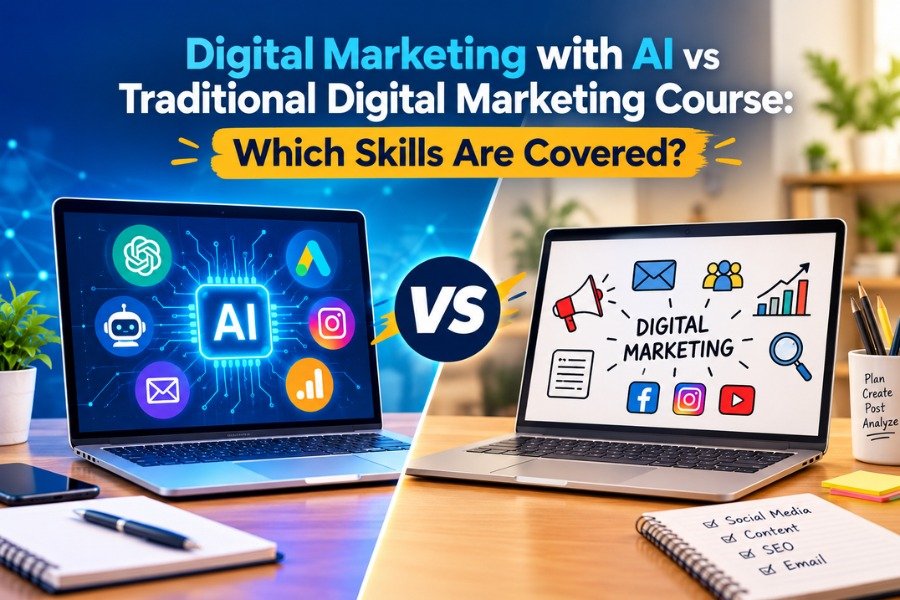
Digital marketing is changing quickly. Imagine two learners starting their careers in India. One learns traditional digital marketing, including SEO, Google Ads, social media marketing and email campaigns. The other learns the same fundamentals while also using AI tools for content creation, campaign analysis, automation and search optimization. Which learner is better prepared for the future?
The answer depends on how well each learner applies their skills. Traditional digital marketing builds the foundation, while AI-powered digital marketing adds new ways to research, create, test and improve campaigns.
For students, graduates, business owners and working professionals, understanding the difference between a digital marketing with AI course and a traditional digital marketing course can help them choose training that matches their career goals.
1. What Is Traditional Digital Marketing?
Quick answer: Traditional digital marketing uses online channels and established marketing techniques to attract audiences, generate leads and increase sales.
Traditional training usually covers search engine optimization (SEO), Google Ads, Meta Ads, social media management, email marketing, content marketing, website analytics and conversion optimization.
For example, a digital marketer might research keywords, write a blog, create a Google Ads campaign and measure website conversions using Google Analytics 4 (GA4).
Practical tip: Choose a course that includes live projects and campaign reporting, not just theoretical lessons.
2. What Is Digital Marketing with AI?
Quick answer: AI-powered digital marketing combines traditional marketing skills with artificial intelligence tools that support research, content production, analysis, personalization and automation.
Learners may explore tools such as ChatGPT, Gemini, Canva AI, and AI video creation platforms. Depending on the syllabus, they may also learn AI-assisted keyword research, customer segmentation, campaign testing and marketing workflow automation.
For example, AI can help generate blog outlines or ad variations. The marketer must still verify facts, understand audience intent and check performance.
Practical tip: Learn how to guide AI with clear instructions, review its output and measure business results.
3. Digital Marketing with AI vs Traditional Digital Marketing: Key Differences
Quick answer: Traditional courses focus on core marketing methods, while AI-enabled courses combine those methods with AI-assisted workflows. Both require strategy, creativity and analytical thinking.
| Skill area | Traditional course | AI-enabled course |
|---|---|---|
| SEO | Keyword research and on-page SEO | AI-assisted research, content analysis and search intent |
| Content marketing | Manual planning and writing | AI-assisted ideation, drafting and editing |
| Paid advertising | Campaign setup and optimization | AI-supported creative testing and analysis |
| Social media | Content calendars and publishing | AI-assisted captions, creative concepts and scheduling |
| Analytics | Reports and performance tracking | AI-assisted interpretation and insights |
| Video marketing | Editing and production workflows | AI-assisted video, voiceover and creative production |
| Automation | Basic marketing workflows | AI-supported workflow design and task automation |
The exact coverage varies by institute. AI tools support marketing decisions; they do not replace sound strategy or human judgment.
4. Which SEO Skills Should a Modern Course Cover?
Quick answer: A strong digital marketing course should teach technical SEO, on-page SEO, content strategy, keyword research, link evaluation, local SEO and performance measurement.
AI-enabled training can extend these skills into Generative Engine Optimization (GEO), Answer Engine Optimization (AEO) and optimization for AI-assisted search experiences.
For example, a learner could improve a course landing page by answering common student questions, adding useful course details, improving internal links and implementing accurate structured data.
Practical tip: Prioritize useful content, crawlability, clear page structure and evidence of expertise. No SEO method guarantees a top ranking or citation in an AI answer.
5. How Does AI Change Content Marketing?
Quick answer: AI can accelerate brainstorming, outlining, editing and content repurposing, but original insight and editorial review remain essential.
A traditional workflow may involve manually researching and drafting an article. An AI-assisted workflow can use AI for an initial outline, followed by human research, expert input, fact-checking and editing.
For instance, one researched webinar could become a blog outline, social media posts and an email newsletter. Each version should be adapted to its audience rather than copied without review.
Practical tip: Use AI to improve the process, not to publish large volumes of generic content.
6. What AI Tools Are Covered in an AI Digital Marketing Course?
Quick answer: Tool coverage depends on the institute and syllabus, but learners may study AI assistants, design platforms, video tools and analytics workflows.
Common examples include:
- Research and writing: ChatGPT and Gemini
- Design and creative production: Canva AI and Adobe Firefly
- Video and avatars: Runway and HeyGen
- Marketing analytics: GA4, advertising dashboards and AI-assisted reporting tools
- SEO research: SEO platforms with AI-assisted features
Tools and features change frequently. Students should learn transferable skills such as prompting, evaluation, campaign planning and data interpretation rather than relying on one platform.
7. Which Paid Advertising Skills Matter?
Quick answer: Both course types should cover audience targeting, budget planning, ad copy, creative testing, conversion tracking and campaign optimization.
AI can help marketers develop alternative headlines, analyze patterns and generate creative ideas. However, a campaign still needs accurate conversion tracking, relevant landing pages and responsible budget management.
For example, a local training institute could test two different ad messages: one focused on practical projects and another on career support. Actual results should guide the decision.
Practical tip: Learn Google Ads and Meta Ads fundamentals before relying on automated bidding or AI-generated creatives.
8. Does an AI Digital Marketing Course Teach Analytics?
Quick answer: A good course should teach measurement using GA4, Google Search Console, advertising reports and conversion tracking, with AI-assisted analysis where appropriate.
Learners should understand sessions, engaged sessions, leads, conversion rate, cost per lead and return on ad spend. AI may help summarize patterns, but incorrect data or tracking errors can produce misleading conclusions.
A useful project is to analyze a campaign, identify its weakest stage and recommend measurable improvements.
Practical tip: Learn to explain why a metric changed, not just how to create a report.
9. Which Course Offers Better Career Opportunities?
Quick answer: Neither course guarantees a job. Employers value practical ability, communication, analytical thinking, portfolio quality and the ability to connect marketing activity to business outcomes.
Traditional skills remain useful across SEO, performance marketing, content and social media roles. AI-related capabilities can add value when they improve productivity and campaign quality.
Potential roles include SEO executive, digital marketing executive, performance marketer, content strategist, marketing analyst and AI-assisted content specialist.
Practical tip: Build a portfolio with campaign plans, keyword research, landing-page audits, ad experiments and performance reports.
10. How Much Does a Digital Marketing Course with AI Cost in India?
Quick answer: Fees vary by institute, course duration, location, trainer experience, project access and included services. Compare the complete curriculum rather than choosing only by price.
Before enrolling, ask whether the fee includes practical assignments, software access, certification preparation, trainer support and placement assistance. Check whether paid third-party tools require separate subscriptions.
Practical tip: Request a written fee breakdown and confirm what is included before paying.
11. How to Choose the Right Course in Delhi NCR
Quick answer: Compare the syllabus, practical training, trainer expertise, student support, project quality and transparency of career claims.
If you are searching for a digital marketing course with AI in Delhi NCR, review the institute’s curriculum and speak with its admissions team. For example, Lakshaya Institute can be considered by learners comparing digital marketing training options, provided they verify the current syllabus and course details directly.
Ask these questions before enrolling:
- Are SEO, Google Ads, Meta Ads and analytics taught in depth?
- Are AI tools integrated into practical projects?
- Will I build a portfolio?
- Are certifications included or only recommended?
- Does placement support mean assistance rather than a guaranteed job?
- Are course fees, duration and refund terms clearly stated?
Do not rely on rankings or promotional claims alone. Make the decision based on verifiable course details.
12. What Should a Future-Ready Curriculum Include?
Quick answer: The strongest curriculum combines marketing fundamentals, practical projects, AI-assisted workflows, measurement and responsible use of technology.
A balanced learning path includes:
- Digital marketing fundamentals and customer research.
- SEO, local SEO, content strategy and website optimization.
- Google Ads, Meta Ads and conversion tracking.
- Social media, email marketing and content production.
- AI prompting, content review and creative workflows.
- Analytics, experimentation and reporting.
- A capstone project using a real or clearly identified practice business.
Students should finish with work they can explain, demonstrate and improve—not just a list of tools they have tried.
Frequently Asked Questions: Digital Marketing with AI vs Traditional Digital Marketing Course
Is an AI digital marketing course better than a traditional course?
An AI-enabled course may offer broader exposure to emerging workflows, but only if it teaches strong marketing fundamentals and practical application. Compare the syllabus and project work before choosing.
Can beginners learn digital marketing with AI?
Yes. Beginners can start with marketing fundamentals and gradually learn AI-assisted research, content creation and analytics. Prior coding experience is generally not necessary for many entry-level marketing tasks.
Do I need to learn SEO before GEO and AEO?
Learning SEO first is useful because search intent, helpful content, technical accessibility and authority remain important. GEO and AEO add considerations for making information clear and useful in AI-powered search experiences.
Which AI tools should digital marketers learn first?
Start with an AI assistant for research and ideation, then learn relevant tools for design, SEO, advertising and analytics. Choose tools based on the tasks you need to perform.
Is a digital marketing course with AI available in Delhi?
Training options are available in Delhi NCR. Compare the latest syllabus, practical projects, fees, schedule and career support before enrolling with any institute.
Does completing the course guarantee placement?
No course should be assumed to guarantee employment. Check the institute’s written placement policy and distinguish placement assistance from a confirmed job offer.
Conclusion: Choose Skills That Deliver Results
The choice between a digital marketing with AI course and a traditional digital marketing course is not simply about old versus new. Traditional marketing provides the foundation; AI adds tools that can make research, production and analysis more efficient when used well.
For learners in India, the most useful course is one that combines SEO, paid advertising, content, analytics and real projects with responsible AI practice. Before enrolling, compare the syllabus, verify the claims and ask to see examples of student work.
The future belongs not to marketers who use the most AI tools, but to marketers who use the right tools to solve real customer problems.