
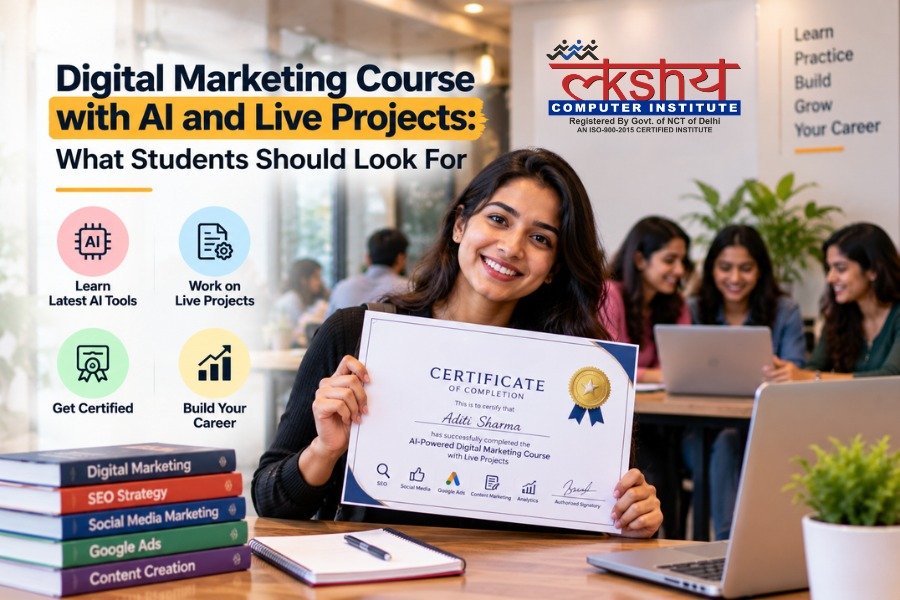
Choosing a digital marketing course can feel confusing. One institute promises quick career growth, another offers certificates, and a third talks about artificial intelligence. But what actually prepares a student for real marketing work?
A Digital Marketing Course with AI and Live Projects should teach students how to plan campaigns, understand customers, use modern AI tools, analyse performance, and solve practical business problems. For students in India, the right course can build skills for agency jobs, in-house marketing roles, freelancing, and entrepreneurship.
At Lakshaya Institute, students exploring digital marketing training should evaluate the curriculum, practical exposure, trainer support, and career guidance before enrolling.
1. What Is a Digital Marketing Course with AI and Live Projects?
Quick answer: It is a practical training programme that combines digital marketing fundamentals, AI-assisted workflows, and projects based on realistic marketing objectives.
Students learn how search engines, social media, paid advertising, websites, analytics, and content work together. AI tools can support research, brainstorming, content creation, and reporting, while live projects help students apply these skills.
Example: A student develops a campaign for a local business, researches keywords, creates landing-page content, plans advertisements, and measures leads.
Practical tip: Choose a course where you create work you can explain and demonstrate in interviews.
2. Why Should Students Learn AI in Digital Marketing?
Quick answer: AI can help marketers work more efficiently, explore ideas faster, and interpret information, but human judgement remains essential.
Modern marketers may use AI to organise research, draft content, generate creative concepts, summarise campaign data, and automate repetitive tasks. They must still verify facts, protect customer information, follow advertising policies, and assess quality.
Example: AI can suggest advertisement variations, but a marketer must test them against real campaign results.
Practical tip: Learn when to use AI, when to check its output, and when human expertise is necessary.
3. Which Skills Should a Good Course Cover?
Quick answer: Look for a balanced curriculum covering SEO, paid advertising, social media, content marketing, analytics, conversion optimisation, and AI-assisted marketing.
A well-rounded syllabus should include:
- Search engine optimisation (SEO) and technical SEO
- Google Ads and Meta Ads
- Social media strategy and content creation
- Website and landing-page optimisation
- GA4, conversion tracking, and reporting
- Email marketing and marketing automation
- Generative Engine Optimisation (GEO) and Answer Engine Optimisation (AEO)
- AI tools for research, creative production, and workflows
Example: Students optimise a webpage and measure its organic traffic and enquiries.
Practical tip: Ask for a detailed syllabus with learning outcomes, not just a list of tools.
4. Why Are Live Projects Important?
Quick answer: Live projects let students practise real marketing tasks, make decisions, review results, and build a portfolio of demonstrable work.
Theory explains marketing concepts, but projects show how to apply them. A project may involve researching an audience, preparing a campaign brief, building a landing page, or evaluating website performance. Actual results depend on budgets, competition, execution, and market conditions.
Example: A student prepares an SEO audit for a business website and recommends improvements to titles, internal links, and page content.
Practical tip: Ask whether projects use real businesses, supervised simulations, or actual campaign accounts.
5. Which AI Tools Should Students Learn?
Quick answer: Students should learn tools that support different marketing tasks rather than memorising a long list of applications.
| Marketing task | Example tools |
|---|---|
| Research and planning | ChatGPT, Gemini |
| SEO research | Semrush, Ahrefs |
| Content optimisation | Surfer SEO |
| Creative design | Canva, Adobe Firefly |
| Video creation | Runway, HeyGen |
| Analytics | Google Analytics 4 |
| Advertising | Google Ads, Meta Ads Manager |
Tools and features change frequently. Some products are paid, and AI-generated outputs require human review.
Practical tip: Prioritise hands-on workflows and transferable skills over tool names alone.
6. How Can Students Evaluate Course Quality?
Quick answer: Compare the syllabus, trainer experience, project depth, feedback process, class format, and support available after training.
A quality course should explain what students will learn, how their work will be assessed, and which resources are included. Students should also ask about batch size, software access, missed classes, and opportunities to practise independently.
Example: Compare two programmes by reviewing their actual project briefs and sample student portfolios.
Practical tip: Attend a demo class and ask specific questions before paying fees.
7. How Do Live Projects Help Build a Portfolio?
Quick answer: A portfolio demonstrates practical skills through project briefs, work samples, decisions, and measurable outcomes where available.
Useful portfolio pieces include an SEO audit, keyword map, content calendar, advertising plan, landing-page wireframe, and analytics report. Students should distinguish practice results from verified business results and obtain permission before sharing confidential client information.
Example: A portfolio case study explains the campaign objective, actions taken, metrics tracked, and lessons learned.
Practical tip: Focus on explaining your thinking, not simply displaying screenshots.
8. How Should Students Compare Digital Marketing Courses?
Quick answer: Compare practical learning and career support alongside fees, duration, location, and certification options.
| Feature | What to check |
|---|---|
| Curriculum | Current, comprehensive, and clearly explained |
| AI training | Practical use with fact-checking |
| Live projects | Relevant tasks and useful feedback |
| Trainers | Relevant professional experience |
| Certifications | Exact issuer and eligibility |
| Career support | Resume guidance, mock interviews, placement assistance |
| Fees | Total cost and any additional charges |
For students seeking a digital marketing course in Delhi, location, commute, classroom schedule, and access to practical sessions may also affect the decision.
Practical tip: Choose based on learning value and career fit rather than promotional claims alone.
9. What Should Students Look for at Lakshaya Institute?
Quick answer: Students considering Lakshaya Institute should review its current course syllabus, AI learning components, project structure, teaching format, and available career support before enrolling.
Ask how the programme combines digital marketing fundamentals with AI-assisted workflows and practical assignments. Confirm which tools are taught, how trainers review student work, and whether the advertised services match your career goals.
Example: Ask to see a sample project brief and understand how feedback is provided.
Practical tip: Verify current fees, duration, certifications, and placement assistance directly with the institute rather than relying on assumptions.
10. Can a Digital Marketing Course Help You Become Job-Ready?
Quick answer: A course can support career preparation, but employability depends on practice, communication, problem-solving, portfolio quality, and market demand.
Potential career paths include SEO executive, digital marketing executive, paid media associate, social media executive, content marketer, and marketing analyst. Freelancing and entrepreneurship are other possibilities, although both require client management and business skills.
Example: A candidate explains an SEO project, justifies keyword choices, and describes how success would be measured.
Practical tip: Practise presenting your work clearly and prepare for practical interview questions.
11. Frequently Asked Questions
Which is the best digital marketing course with AI and live projects?
The best course is one that matches your goals, teaches core marketing skills, includes meaningful practical work, and provides clear trainer and career support. Compare the syllabus and sample projects before enrolling.
Do beginners need coding skills?
No. Most digital marketing fundamentals can be learned without coding. Basic HTML, website concepts, and data interpretation can become useful as you progress.
Is AI replacing digital marketers?
AI is changing marketing workflows, but strategy, customer understanding, creative judgement, ethical decision-making, and performance analysis remain important. Learning to use AI responsibly can complement these skills.
Can I learn digital marketing in Delhi through classroom training?
Yes, classroom programmes are available in Delhi. Check the current schedule, location, curriculum, project format, and fees directly with the institute.
Does completing a course guarantee a job?
No course should be assumed to guarantee employment. Ask what career assistance is provided and review the eligibility criteria and terms of any placement-related claims.
Conclusion: Choose Practical Skills Over Promises
A Digital Marketing Course with AI and Live Projects should help students move from understanding marketing concepts to applying them confidently. Look for a current curriculum, meaningful assignments, responsible AI use, portfolio development, and transparent career support.
If you are considering Lakshaya Institute, review its course details, discuss your career goals with the team, and ask how practical projects fit into the learning process.
The most valuable course is not the one that teaches the most tools—it is the one that helps you solve real marketing problems.