
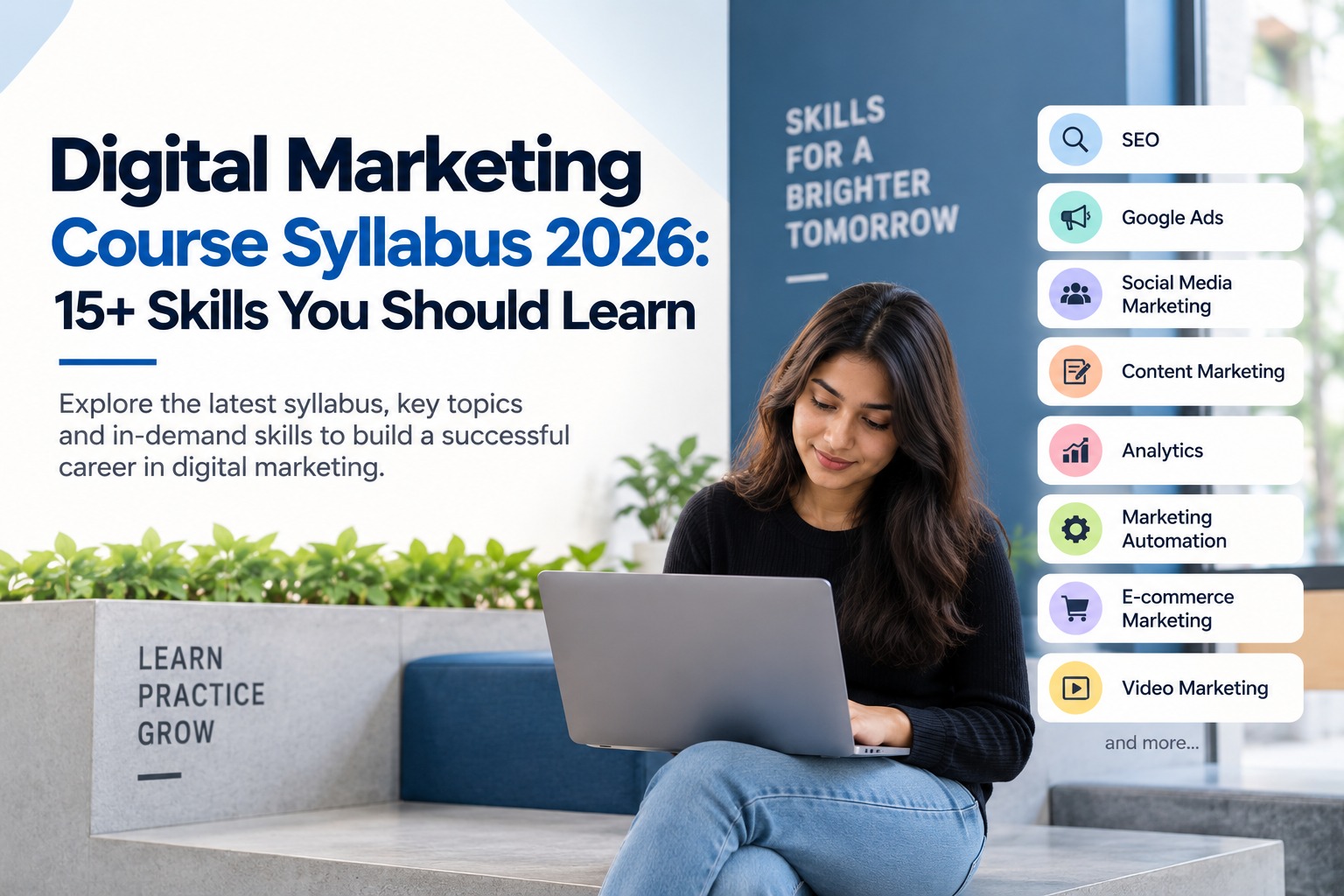
Digital marketing is no longer just about posting on social media or running advertisements. A modern marketer needs to understand search, content, paid advertising, analytics, websites, customer journeys, and AI-powered tools.
So, if you are comparing a Digital Marketing Course Syllabus in 2026, the real question is not simply “How many modules are included?” It is: Will the syllabus teach you how to plan, execute, measure, and improve real campaigns?
For learners in India, especially Delhi NCR, this practical approach matters because digital marketing roles span agencies, startups, e-commerce businesses, local businesses, and in-house marketing teams.
What Is a Digital Marketing Course Syllabus?
A Digital Marketing Course Syllabus is a structured roadmap covering the skills and tools used to attract, engage, convert, and retain customers through digital channels. A strong 2026 syllabus should combine marketing fundamentals with SEO, paid advertising, social media, content, analytics, websites, and AI.
Lakshaya Institute’s Diploma in Digital Marketing covers SEO, SEM/PPC, social media, affiliate marketing, content marketing, email marketing, WordPress, graphic-design basics, analytics, and performance tracking.
1. Digital Marketing Fundamentals
Quick answer: Start with the fundamentals before learning individual platforms.
You should understand target audiences, customer journeys, marketing funnels, digital channels, campaign objectives, KPIs, and basic strategy.
Practical tip: Before launching an ad, define the audience, offer, objective, landing page, and success metric.
2. Search Engine Optimization (SEO)
Quick answer: SEO teaches you how to improve a website’s visibility in organic search.
A modern syllabus should cover keyword research, search intent, on-page SEO, technical SEO, internal linking, content optimization, off-page SEO, local SEO, and SEO measurement.
Lakshaya’s published curriculum includes keyword analysis, on-page optimization, meta tags, URL optimization, backlinks, local listings, and other SEO activities.
Practical example: Optimize a local business page for searches such as “digital marketing course in Delhi.”
3. Google Ads & PPC
Quick answer: PPC training teaches you how to create and optimize paid search campaigns.
Important skills include keyword research, campaign structure, bidding, ad assets, conversion tracking, remarketing, and performance analysis.
Lakshaya’s syllabus includes Search, Performance Max, Display, Shopping, Video and other Google Ads formats, along with campaign settings and conversion setup.
4. Social Media Marketing
Quick answer: Social media training covers both organic growth and paid promotion.
Learn platform strategy, content planning, audience targeting, engagement, campaign objectives, creative testing, and reporting across platforms such as Facebook, Instagram and LinkedIn.
Practical tip: Learn to connect every post or campaign with a measurable business objective.
5. Content Marketing
Quick answer: Content marketing focuses on creating useful content that attracts and helps the right audience.
The syllabus should cover blogs, landing-page content, social posts, content calendars, SEO content, storytelling, and content distribution.
Example: A digital marketing institute could create beginner guides, course comparisons, student resources, and career content to attract prospective learners.
6. Email Marketing
Quick answer: Email marketing helps businesses nurture prospects and existing customers.
Students should learn newsletters, lead nurturing, segmentation, automation, subject lines, calls to action, and performance measurement.
The goal is not simply sending emails—it is understanding why a subscriber should open, read, and act.
7. WordPress & Website Development
Quick answer: Digital marketers benefit from understanding how websites and landing pages work.
Lakshaya’s published Digital Marketing syllabus includes website development and WordPress, helping students understand how marketing campaigns connect with websites and landing pages.
Practical tip: Build at least one simple business website and optimize it for search and conversions.
8. Analytics & Performance Marketing
Quick answer: Analytics turns marketing activity into measurable insights.
Learn traffic analysis, campaign KPIs, conversion tracking, attribution basics, reporting, and performance optimization.
A marketer should be able to answer: Where did the visitors come from, what did they do, and which channel produced results?
9. Affiliate Marketing
Quick answer: Affiliate marketing teaches how businesses use partners and publishers to generate measurable sales or leads.
A good module should cover affiliate models, tracking, commissions, partner selection, content promotion, and compliance.
10. Graphic Design for Marketers
Quick answer: Marketers need basic design skills to communicate ideas effectively.
Learn creative fundamentals, social-media designs, ad creatives, banners, presentations, and tools such as Canva.
You do not need to become a professional designer, but you should understand how visual hierarchy affects attention and conversions.
11. AI-Powered Digital Marketing
Quick answer: AI should be taught as a productivity and strategy layer across digital marketing—not as a replacement for marketing fundamentals.
Students can use AI for research, ideation, content workflows, campaign analysis, creative variations, customer insights, and productivity.
Google’s current search guidance emphasizes that traditional SEO fundamentals remain relevant for generative search experiences, while useful, original content remains important.
12. Conversion Rate Optimization (CRO)
Quick answer: CRO focuses on turning existing traffic into more leads, enquiries, or sales.
Learn landing-page structure, calls to action, forms, user experience, testing concepts, and funnel optimization.
Example: If 1,000 people visit a course page but very few enquire, the problem may be the offer, page experience, messaging, or conversion path—not traffic volume alone.
13. Local SEO
Quick answer: Local SEO helps businesses become more visible to customers searching within a specific location.
For Delhi learners, practical exercises can include optimizing location pages, Google Business Profile information, local content, reviews, citations, and “near me” search intent.
Lakshaya has course pages targeting Delhi NCR locations including Dwarka, Uttam Nagar, Sagarpur, Janakpuri and West Delhi.
14. Marketing Strategy & Campaign Planning
Quick answer: Strategy connects individual marketing channels into one business plan.
Students should learn audience research, competitor analysis, positioning, campaign objectives, budgets, channel selection, KPIs, and reporting.
Practical tip: Build a complete campaign brief before touching an advertising platform.
15. Practical Projects & Portfolio Building
Quick answer: Projects turn theoretical knowledge into demonstrable skills.
A strong course should give students opportunities to create websites, SEO plans, content calendars, paid campaigns, reports, and marketing strategies.
Lakshaya states that its Digital Marketing program includes live projects, hands-on training, and real-time campaign execution.
Digital Marketing Syllabus: What Should You Look For?
| Skill | Beginner | 2026 Career Value |
|---|---|---|
| SEO | Essential | High |
| Google Ads | Essential | High |
| Meta/Social Ads | Essential | High |
| Content Marketing | Essential | High |
| Analytics | Essential | High |
| WordPress | Useful | High |
| Email Marketing | Useful | Medium–High |
| Local SEO | Useful | High |
| CRO | Intermediate | High |
| AI Marketing | Emerging/Essential | High |
| Affiliate Marketing | Optional | Medium |
| Graphic Design | Supporting skill | Medium–High |
Why Choose Lakshaya Institute?
Lakshaya Institute combines digital marketing concepts with practical learning and career-oriented training. Its published course offers regular, fast-track and crash options, with classroom and online learning available. The institute also highlights live projects, case studies, practical training and placement assistance.
Lakshaya was founded by Neeraj Aggarwal in 2014. Its official founder profile describes a focus on practical learning, mentorship, adapting courses to industry trends, and a student-first approach.
Digital Marketing Course Syllabus 2026: Frequently Asked Questions
What is the Digital Marketing Course Syllabus in 2026?
A modern syllabus should cover SEO, Google Ads, social media marketing, content, email, analytics, WordPress, local SEO, CRO, marketing strategy, and AI-powered marketing.
Is Digital Marketing a good career option in India?
Digital marketing can offer opportunities across agencies, startups, e-commerce, local businesses and in-house marketing teams. Your results will depend on your skills, practical experience, portfolio, and ability to adapt.
How long is Lakshaya Institute’s Digital Marketing Course?
Lakshaya lists the Diploma in Digital Marketing as 6 months regular, 3 months fast-track, and 2 months crash training.
Is practical training important in a Digital Marketing Course?
Yes. Practical projects help students move from understanding concepts to actually executing campaigns, analyzing results, and building a portfolio.
Final Takeaway
The best Digital Marketing Course Syllabus 2026 is not the one with the longest list of tools. It is the one that teaches you how to think like a marketer, use technology intelligently, measure results, and solve real business problems.
For Indian learners considering a Digital Marketing Course in Delhi, compare the syllabus, practical projects, trainers, learning format, career support, and transparency of course claims before enrolling.
Learn the tools. Build the projects. Understand the strategy. That is what turns digital marketing knowledge into a career skill.