
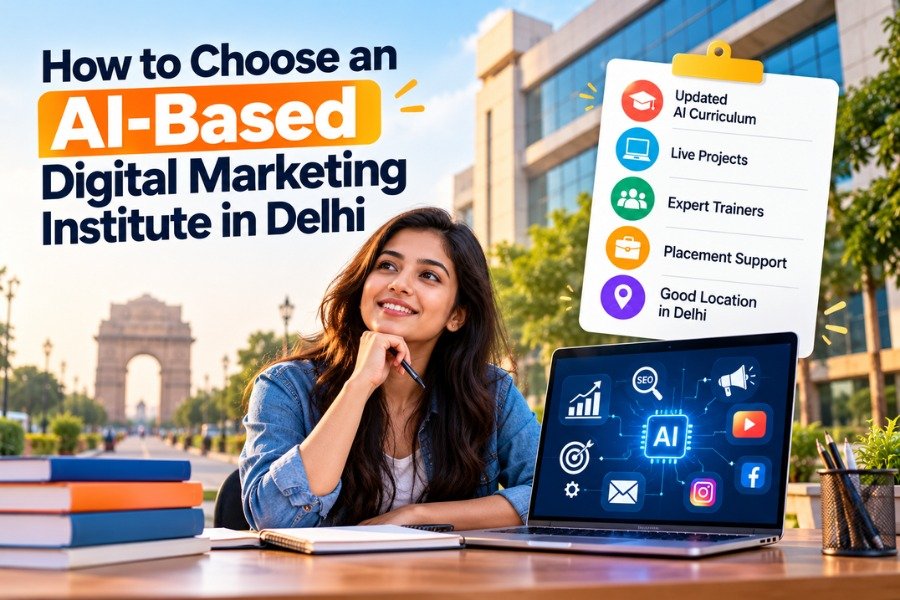
An AI-based digital marketing course can help learners prepare for a changing job market by combining traditional marketing skills with AI tools, analytics, automation, and content strategy. For students and working professionals in India, it can open pathways into SEO, performance marketing, social media, content creation, and emerging AI-focused marketing roles.
The key is to learn more than tools. Employers need people who can understand customers, build campaigns, measure results, and use AI responsibly to improve business outcomes.
1. What Is the Career Scope After an AI-Based Digital Marketing Course?
Quick answer: Graduates can pursue roles in SEO, paid advertising, social media, content marketing, marketing analytics, marketing automation, and AI-assisted content production.
AI-based digital marketing combines core marketing principles with tools that support research, content development, campaign optimization, reporting, and customer communication. For example, a marketer might use AI to develop campaign ideas, Google Analytics to evaluate performance, and search data to improve website content.
The strongest career opportunities come from combining AI proficiency with sound marketing judgment.
Practical tip: Build a portfolio with at least three projects: an SEO campaign, a paid advertising plan, and an AI-assisted content campaign.
2. What Jobs Can You Get After an AI Digital Marketing Course?
Quick answer: Beginners can target executive, coordinator, and junior specialist roles. With experience and measurable results, they can progress into specialist, strategist, manager, or consulting positions.
| Job role | Main responsibilities |
|---|---|
| SEO Executive | Improve rankings, technical SEO, and organic visibility |
| Performance Marketing Executive | Manage Google Ads and Meta Ads campaigns |
| Social Media Executive | Plan content, publishing, and audience engagement |
| AI Content Specialist | Create and review AI-assisted marketing content |
| Digital Marketing Analyst | Track traffic, leads, conversions, and campaign results |
| Marketing Automation Executive | Build email workflows and customer journeys |
| GEO/AEO Content Specialist | Structure useful content for answer engines and AI-assisted discovery |
Job titles vary by company, and some emerging roles may be combined with existing SEO or content positions.
3. Which Skills Should You Learn for Career Growth?
Quick answer: Learn SEO, paid advertising, content strategy, analytics, conversion optimization, AI prompting, and communication. These skills help you turn marketing ideas into measurable results.
A practical learning path includes:
- SEO: Keyword research, technical SEO, internal linking, and content optimization.
- Paid advertising: Google Ads, Meta Ads, audience targeting, and budget management.
- Analytics: GA4, conversion tracking, and reporting.
- AI tools: Research assistance, content workflows, image and video creation, and automation.
- GEO and AEO: Clear, evidence-based content that answers questions and supports accurate information retrieval.
- Business skills: Copywriting, customer understanding, presentation, and campaign planning.
Practical example: Instead of simply generating a blog with AI, research the search intent, verify facts, add expert input, optimize the page, and measure organic traffic and leads after publication.
4. What Is the Salary After an AI-Based Digital Marketing Course in India?
Quick answer: Entry-level digital marketing salaries often fall around ₹2.5–₹5 lakh per year, but actual offers depend on location, practical ability, company size, and previous experience. AI skills may improve productivity, but they do not guarantee a higher salary.
| Career stage | Illustrative annual salary |
|---|---|
| Fresher | ₹2.5–₹5 lakh |
| Junior specialist | ₹4–₹8 lakh |
| Experienced specialist | ₹8–₹15 lakh |
| Manager or strategist | ₹10–₹20 lakh+ |
These are indicative ranges, not guaranteed salaries; individual roles can fall below or above them. Performance marketers, technical SEO specialists, and analytics professionals may earn more when they can demonstrate measurable business results.
Practical tip: In interviews, show what you improved—such as conversion rate, qualified leads, organic traffic, or cost per lead—instead of relying only on certificates.
5. How Is AI Changing Digital Marketing Careers?
Quick answer: AI is helping marketers automate repetitive tasks, analyse information, test creative ideas, and personalise campaigns. Human judgment remains essential for strategy, accuracy, creativity, and customer trust.
The World Economic Forum’s Future of Jobs Report 2025 identifies AI and big data among the fastest-growing skill areas through 2030. It also highlights creative thinking, analytical thinking, flexibility, and lifelong learning.
For example, AI can suggest advertising headlines, but a marketer must verify claims, understand the target audience, and determine whether the campaign generates valuable leads.
Practical tip: Use AI to speed up your workflow, not to replace research, fact-checking, or original thinking.
6. Which AI and Digital Marketing Tools Should You Learn?
Quick answer: Start with tools that match your chosen career path. Learn the fundamentals first, then use AI tools to improve research, content, campaign management, and reporting.
| Skill area | Tools to explore |
|---|---|
| SEO and research | Google Search Console, Semrush |
| Advertising | Google Ads, Meta Ads Manager |
| Analytics | Google Analytics 4, Looker Studio |
| AI-assisted content | ChatGPT, Gemini |
| Creative production | Canva, AI video tools |
| Automation | Email marketing and workflow automation platforms |
You do not need to master every platform. Employers value your ability to choose the right tool and use it to solve a real marketing problem.
7. Is GEO and AEO Important for Future SEO Careers?
Quick answer: GEO (Generative Engine Optimization) and AEO (Answer Engine Optimization) focus on making information useful and understandable for AI-powered search experiences and direct-answer systems. They complement SEO rather than replace its fundamentals.
Marketers should focus on accurate information, clear headings, helpful answers, credible sources, relevant internal links, and strong website foundations. No method can guarantee that Google AI Overviews or another AI assistant will cite a particular page.
Practical tip: Write a clear answer to the reader’s main question near the beginning of each important page, then support it with examples and evidence.
8. Can You Work as a Freelancer or Start an Agency?
Quick answer: Yes. Skilled marketers can offer SEO, advertising management, social media, content strategy, and AI-assisted creative services to small businesses and larger clients.
A beginner might start by creating a website audit or social media plan for a local business. With experience, they can build recurring client relationships or develop a specialist agency.
Practical tip: Start with one service, define what the client will receive, agree on measurable goals, and build a portfolio using genuine project results.
9. How Can You Get Your First Digital Marketing Job?
Quick answer: Combine structured learning with practical projects, a clear portfolio, and interview preparation. Employers need evidence that you can apply your knowledge.
Follow this five-step plan:
- Learn SEO, advertising, content marketing, and analytics fundamentals.
- Complete practical projects using real or clearly labelled sample data.
- Build a portfolio with campaign plans, reports, and examples of your work.
- Improve your resume and LinkedIn profile with specific skills and outcomes.
- Apply for internships, junior roles, and entry-level specialist positions.
Practical tip: Practise explaining why you selected a strategy, how you measured results, and what you would improve next time.
10. Why Choose Lakshaya Institute for AI-Based Digital Marketing Training?
Quick answer: When comparing institutes, look for practical projects, relevant AI tools, trainer support, current marketing skills, and transparent career assistance.
For students considering Lakshaya Institute in Delhi, review the course syllabus, ask for a demonstration class, and confirm which tools and projects are included. Check the terms of any placement assistance before enrolling.
A useful course should help learners develop practical skills rather than promise a job simply for completing the programme.
Practical tip: Ask to see a sample project, understand how performance is assessed, and verify claims about certifications, student outcomes, and placement support.
11. What Will Digital Marketing Careers Look Like Between 2026 and 2030?
Quick answer: Digital marketing is likely to become more data-driven and AI-assisted. Professionals who combine technical skills with creativity, communication, and business understanding will be better prepared for changing requirements.
The World Economic Forum expects technological skills and human capabilities such as analytical thinking and adaptability to become increasingly important by 2030. These are broad employer expectations, not a guarantee of growth for every marketing job.
Practical tip: Review your skills every six months, test new tools, and keep learning from campaign results rather than following every new AI trend.
Conclusion
A career after an AI-based digital marketing course can lead to several professional paths, from SEO and performance marketing to analytics, automation, and content strategy. The most reliable route is to learn core marketing skills, practise with relevant AI tools, build real projects, and demonstrate measurable results.
AI can help you work faster, but your ability to think strategically and solve business problems is what makes your skills valuable..